
Queue Management System in Saudi Arabia: 2026 Guide
Every service counter has the same silent enemy: the line. A well-chosen queue management system in saudi arabia turns that line from a source of complaints into a measurable, controllable flow. In 2026, with digital government services expanding under Vision 2030, customers expect to be called by a screen or a phone, not by a shouting clerk.
This guide is written for telecom retail managers, branch heads and operations teams. It explains how modern ticketing works, what to compare before buying, and how to roll one out without disrupting daily business.
Why waiting lines hurt telecom and service businesses
A telecom service center handles very different visits at once. One customer wants a quick SIM replacement. Another needs a long device-financing discussion. Put both in one physical line and the quick visit waits behind the slow one.
The cost is real. Walk-aways reduce sales, long waits raise complaint volumes, and staff spend energy managing tempers instead of serving people. Three effects show up most often:
- Customers leave before they are served, so sales are lost.
- Counters sit idle while others are overloaded, because nobody sees the whole picture.
- Managers lack data, so staffing decisions rely on guesswork.
How a modern queue management system works
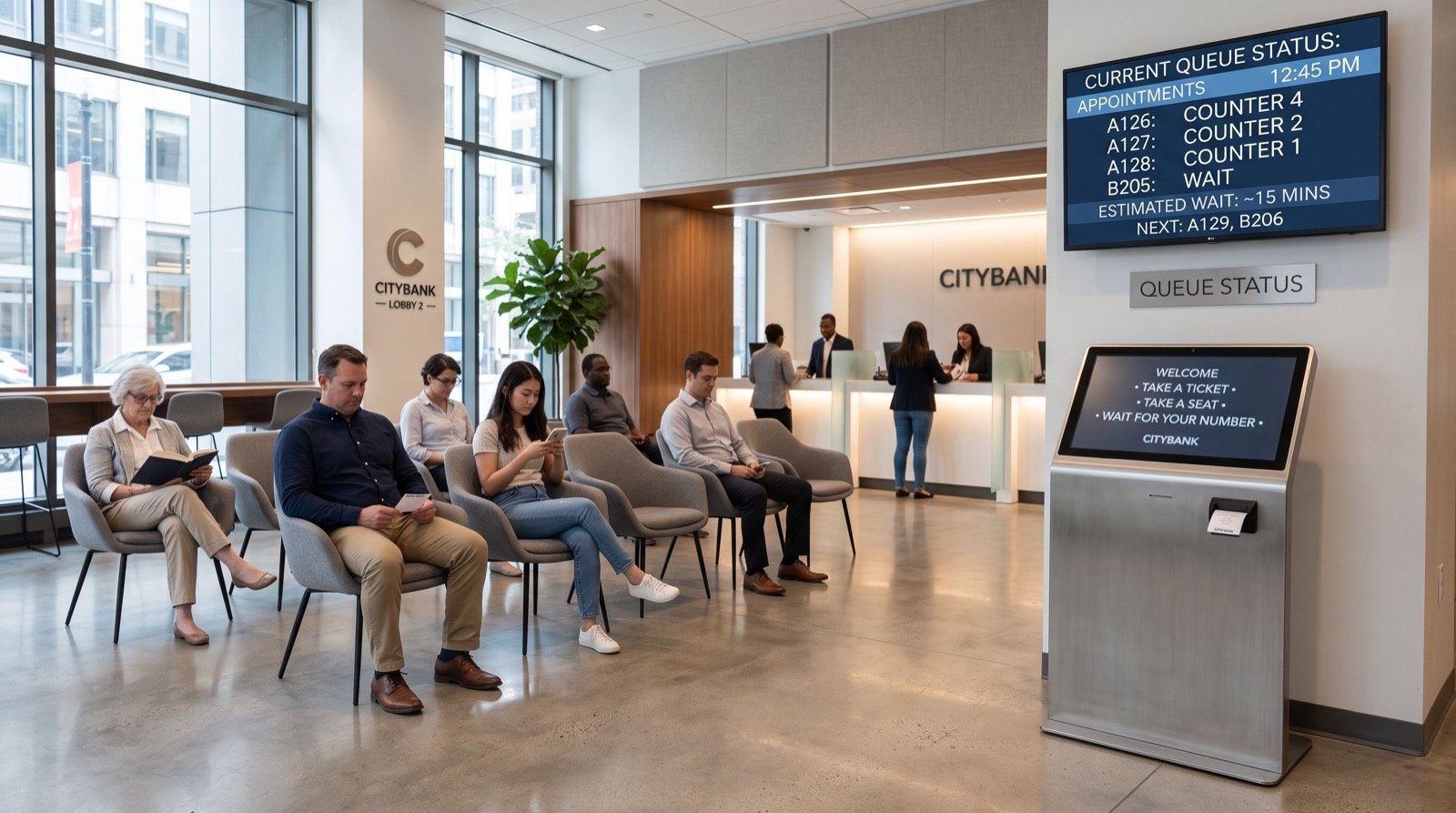
The idea is simple. A customer takes a ticket, from a kiosk, a mobile app or a QR code. The system sorts that ticket by service type and priority. A display and an audio announcement then call the number to the right counter.
The core components
- Ticket dispenser or mobile ticketing so customers choose a service category.
- Central software that routes tickets to the correct counter and tracks every timestamp.
- Counter terminals where staff call, transfer or close a ticket.
- Display screens and audio that announce the next number, often in Arabic and English.
- Reporting dashboards showing waiting time, service time and peak hours.
Remote and virtual queuing
The biggest shift in recent years is remote ticketing. Customers join the queue from a phone, then wait in a cafe or their car. For a mall-based telecom store in Riyadh or Jeddah, this alone frees the entrance and improves the shopping experience around you.
What is the best queue management system for a Saudi branch?
There is no single winner. The right pick depends on branch size, languages, and how your teams already work. Use the table below as a quick comparison of the main approaches.
| Approach | Best for | Strength | Limitation |
|---|---|---|---|
| Basic ticket and display | Small shops, clinics | Low cost, quick setup | Little reporting |
| Multi-service routing | Telecom retail, banks | Skill-based routing, transfers | Needs staff training |
| Mobile and remote queue | Malls, busy city branches | Customers wait anywhere | Requires smartphone use |
| Enterprise multi-branch | National chains | Central analytics across sites | Higher project effort |
In our experience, the multi-service model delivers the best return for telecom stores because visit types vary so widely. Mobile queuing is then added as a second phase once staff are comfortable.
Queue management beyond one country: a Karachi comparison
Businesses operating across the region often ask whether one design fits both markets. The core logic does, but local habits differ. A queue management system in karachi usually has to cope with very high walk-in volumes, frequent power cuts and a stronger preference for Urdu announcements. Saudi branches more often prioritize bilingual Arabic and English screens, appointment integration and government-platform links.
The lesson is to buy a platform that is configurable, not one hard-coded for a single market. That keeps rollout simple if your business expands from Karachi to Dammam or the other way round.
A practical rollout plan
Step 1: Measure the current situation
Before buying anything, spend one week recording average wait, longest wait and the busiest hours. Even a stopwatch and a notebook give you a baseline you can compare against later.
Step 2: Define service categories
Keep the list short. Five to seven categories, such as new connection, bill payment, device support and complaints, are enough. Too many choices confuse customers at the kiosk.
Step 3: Choose placement carefully
Put the kiosk where customers see it on entry, and place screens where seated customers can read them. A common mistake is hanging a display behind a pillar.
Step 4: Train and launch
Run a short pilot in one branch. Collect staff feedback for two weeks, then adjust categories and call rules before wider launch. Similar planning discipline matters in any project involving contractors; when you hire reputable service experts, a checklist before installation avoids expensive surprises, and the same goes for kiosks and cabling.
Metrics that prove the system works
Track a small set of numbers every month. They tell you whether the investment is paying back.
- Average waiting time, targeting a steady downward trend.
- Abandonment rate, the share of tickets never served.
- Average service time per category.
- Peak-hour load, to align shifts with demand.
- Customer rating collected on a feedback keypad.
An original tip: review the abandonment rate by hour, not by day. A branch that looks fine on average often has two or three terrible hours that account for most walk-aways, and fixing those is cheaper than adding staff all day.
Connectivity and compliance considerations
Reliable networking is the backbone of any ticketing deployment. Wired connections are preferred for kiosks and counter terminals, with wireless used for remote ticketing and displays. Customer data, such as phone numbers used for SMS alerts, should be handled in line with national rules. Saudi organizations can consult the Communications, Space and Technology Commission at cst.gov.sa for regulations covering telecom and digital services in 2026.
Frequently Asked Questions
How long does installation take?
A single-branch setup typically takes a few days for hardware and one more week for configuration, training and testing.
Can customers get notified by SMS or WhatsApp?
Yes. Most modern platforms send a notification when the customer is a few tickets away, so they can step out and return on time.
Does it work with Arabic announcements?
Yes. Quality systems support Arabic and English display and voice calls, and some add Urdu for multilingual teams.
Is a queue system worth it for a small branch?
If you regularly see more than five people waiting, usually yes. Even a basic ticket and display setup improves fairness and reduces tension at the counter.
Conclusion
A thoughtful queue management system in Saudi Arabia reduces waiting, protects sales and gives managers the data they need in 2026. Start by measuring, keep categories simple, pilot first, and review results monthly. Ready to compare options for your branches? Reach out to a specialist and ask for a demo built around your own visit types.