
Walk through the storage area of almost any trading company in Saudi Arabia and you will find the same quiet problem: goods with completely different needs sitting under one roof. Gasket kits stacked two aisles from cartons of dates. Electronics beside drums of cleaning chemicals. Frozen samples in a domestic chest freezer by the office door. It all works, until the day it does not.
The Kingdom’s import economy encourages this drift. Businesses in Jeddah and Riyadh tend to grow by adding product lines rather than deepening a single one, and each new line arrives faster than the warehousing strategy can adapt. The result is inventory that merely survives storage instead of being protected by it — and losses that never appear on any single invoice, only in the year-end margin.
Why the single-warehouse model breaks down
Every product category has a tolerance band: a range of temperature, humidity, dust exposure, and handling frequency it can absorb before value starts leaking away. A steel bracket shrugs off heat that would ruin chocolate in an afternoon. A sealed bearing tolerates months of stillness that would bankrupt a fresh-dairy line. Put them in the same room and the room ends up calibrated for nothing in particular.
The financial consequence is subtle but constant. You pay to condition air for products that never needed conditioning, while the products that genuinely needed it receive a compromise. Insurance assessors notice mixed-risk storage too, and premiums tend to reflect what they find.
Workflow suffers alongside the goods themselves. Fast-moving retail cartons and slow-moving industrial components demand opposite picking rhythms, and forcing both through one receiving dock creates congestion that neither operation would generate on its own. Staff trained to handle one category carelessly handle the other, because the building itself signals that everything is interchangeable.
Begin with an honest storage audit
Before comparing facilities or negotiating rates, map what you actually hold. Most Saudi trading inventories resolve into a handful of environmental groups:
- Deep-frozen goods — meat, seafood, ice cream, and frozen bakery lines that must remain at minus eighteen degrees Celsius or colder without interruption.
- Chilled goods — dairy, fresh produce, and certain pharmaceuticals living between two and eight degrees.
- Climate-sensitive dry goods — electronics, cosmetics, packaging films, and anything that fears humidity more than heat.
- Engineered components — spare parts, fasteners, filters, and sub-assemblies that need dryness, traceability, and racking designed around part numbers.
- Robust general cargo — items that genuinely can sit in basic ambient space without harm.
The exercise usually surprises people. A category everyone assumed was general cargo often turns out to carry manufacturer storage conditions printed on the packaging, ignored since the first container landed. Write the findings down; the list becomes the specification for every facility conversation that follows.
Spare parts deserve engineering, not just shelving
Component inventory is the category most often mistreated, largely because the damage stays invisible for months. Corrosion, seal degradation, and label fade rarely announce themselves when they happen; they surface a year later as warranty claims, rejected installations, and emergency airfreight. Dust is a genuine adversary in Saudi conditions, working its way into threads and hydraulic fittings through packaging that still looks intact.
Purpose-built Storage for Spare Parts addresses this with sealed environments, humidity control, and racking organised around part numbers rather than pallet counts. Just as valuable is the inventory discipline that comes with it — bin-level locations, batch traceability, and first-in-first-out rotation — so a technician’s urgent order ships the same afternoon instead of triggering a two-hour search through mislabeled boxes.
For distributors supporting fleets, factories, or construction equipment across the Kingdom, that reliability is the actual product. The part itself is a commodity; the ability to produce the correct part, undamaged and documented, on the day a machine stands idle is what contracts are renewed on.
Frozen lines are a separate discipline entirely
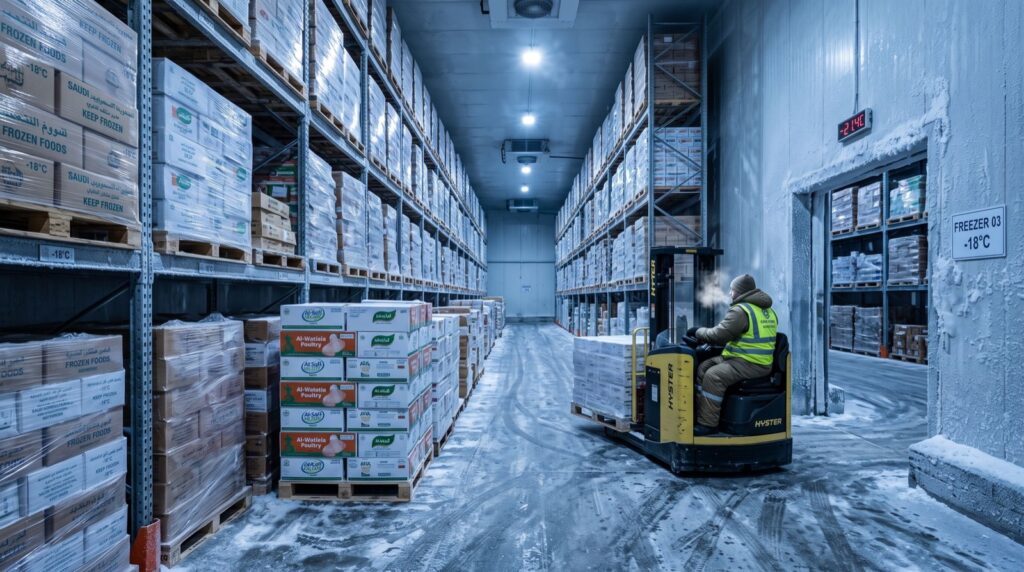
If component storage rewards patience, frozen storage demands vigilance. A freezer chamber is not simply a colder warehouse; it is a machine that must run perfectly around the clock, in a climate where ambient conditions fight it for most of the year. Every door opening, every partial load, every delayed transfer takes a bite out of shelf life that no one can put back.
For importers bringing product through the Islamic Port, professional Frozen Storage in Jeddah shortens the most dangerous leg of the cold chain — the gap between container discharge and controlled storage. Facilities positioned near the port, equipped with redundant compressors, backup generation, and continuous temperature logging, turn that gap from a gamble into a procedure.
Documentation matters nearly as much as the cold itself. Saudi food authorities expect a verifiable temperature history, and a facility that generates those records automatically spares you the miserable task of reconstructing evidence in the middle of an inspection.
The cost logic of splitting your footprint
Owners sometimes resist dividing inventory across facilities because two contracts sound more expensive than one. In practice the arithmetic usually runs the other way. Refrigerated space costs several times more per square metre than ambient space, so every pallet of durable hardware parked in a cold room is money actively evaporating through the compressor.
Splitting the footprint means paying premium rates only for the fraction of stock that justifies them. It also isolates risk: a compressor failure, a fire, or a flood in one building no longer threatens the entire inventory at once. Many firms go further and split geographically — bulk reserves near the Jeddah port, fast-moving stock closer to Riyadh demand — trimming both storage cost and delivery time in a single decision.
Vet the operator, not just the building
A gleaming facility run carelessly is worse than a modest one run well. Ask prospective warehousing partners how they handle power interruptions, how often sensors are calibrated, who answers the phone at two in the morning, and what their claims history looks like. The vetting mindset is the same one you would apply to quality service providers in any other field: verifiable track record first, promises second.
Visit unannounced if you can. Notice whether dock doors actually seal, whether staff log movements as they happen or in batches at shift end, and whether the temperature displays match what the contract guarantees. Ten minutes on the warehouse floor reveals more than any brochure will.
One inventory, several right answers
The businesses that scale smoothly in the Saudi market share a habit: they treat storage as part of product quality rather than a cost to be minimised. Matching each category to its proper environment takes a little planning up front and repays it in fewer write-offs, calmer audits, and customers who never learn how close their order came to being ruined.
Start with the audit, split where the numbers say to split, and hold every facility — and every operator — to the standard your inventory actually requires. The warehouse should be the least dramatic part of your business. That is exactly what makes it worth getting right.