
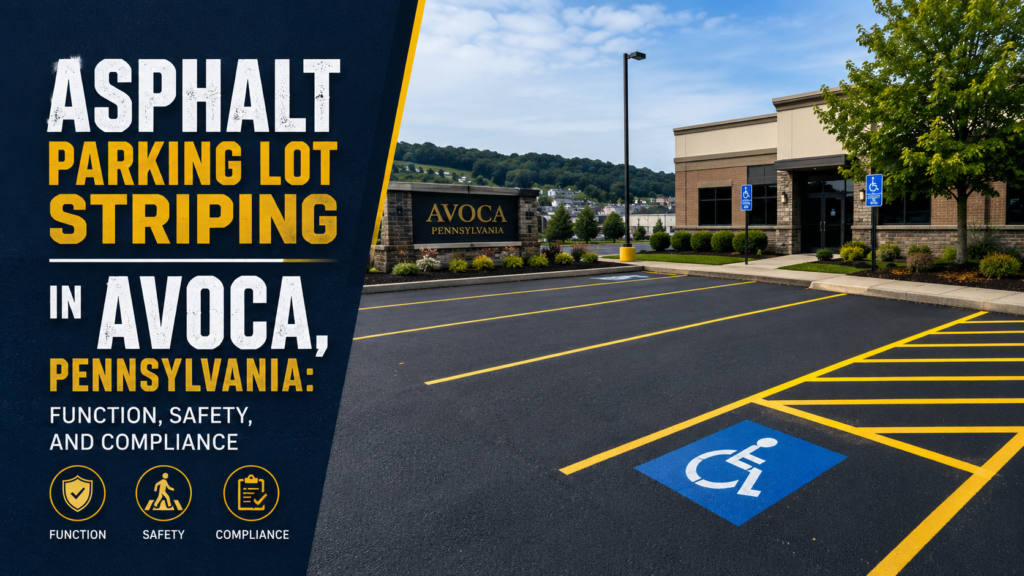
Asphalt Parking Lot Striping Avoca may appear to be one of the simpler aspects of pavement management, but it performs an outsized role in how a commercial or institutional property functions on a daily basis. For businesses, municipal facilities, schools, churches, and other property owners in Avoca, Pennsylvania and across Lackawanna-Luzerne County, properly applied, clearly visible, and ADA-compliant parking lot striping is simultaneously a safety measure, a legal requirement, and a signal to customers and visitors that the property is well-maintained and professionally managed.
What Parking Lot Striping Involves
Parking lot striping is the application of traffic-grade paint or thermoplastic markings to a paved surface to define parking spaces, traffic lanes, pedestrian crosswalks, fire lanes, loading zones, accessible (ADA) parking spaces, and any other functional zones within the lot. The markings communicate the intended use of every area of the lot to drivers and pedestrians, creating predictable, safe traffic patterns.
Professional striping involves more than simply painting lines. It requires:
- Layout planning: Determining the optimal parking space layout for the lot balancing the number of spaces against the need for safe traffic circulation, required accessible spaces, fire lane widths, and pedestrian access routes.
- Measurement and marking: Precise measurement and marking of space locations, angles, and dimensions before paint application to ensure consistent spacing and accurate ADA-required dimensions.
- Equipment selection: Traffic-grade striping machines apply paint at consistent width, thickness, and opacity. Proper equipment ensures lines that are visible, durable, and consistent across the entire lot.
- Paint selection: Traffic-grade water-based or solvent-based paints designed for asphalt surfaces provide the adhesion, UV resistance, and durability required for exterior pavement markings in Pennsylvania’s climate.
ADA Compliance: The Legal Framework for Accessible Parking
The Americans with Disabilities Act (ADA) establishes specific, enforceable requirements for accessible parking spaces on any property that is open to the public. Non-compliance with these requirements exposes property owners to enforcement actions, fines, and civil litigation. The requirements include:
- Minimum number of accessible spaces: The required number scales with the total number of spaces in the lot. A lot with 1 to 25 spaces requires 1 accessible space. Larger lots require more. At least one accessible space per lot must be van-accessible.
- Space dimensions: Standard accessible spaces must be at least 8 feet wide. Van-accessible spaces must be at least 8 feet wide with an adjacent 8-foot access aisle (or at least 11 feet wide with a 5-foot aisle).
- Access aisles: Access aisles the striped zones beside accessible spaces that allow wheelchair users to enter and exit safely must be properly dimensioned, level, and located on the correct side of the space.
- Slope limitations: ADA accessible spaces and their access aisles must not exceed a 2% slope in any direction. Spaces placed on sloped sections of a lot are a common compliance failure.
- Signage: Each accessible space must be identified with the International Symbol of Accessibility on a vertical sign mounted at the correct height. Pavement symbols alone are insufficient.
ADA violations carry significant financial exposure. The U.S. Department of Justice can impose civil penalties of up to $75,000 for first violations and up to $150,000 for repeat violations. Private litigation by individuals who cannot access a property due to non-compliant striping is also common.
When Restriping Is Required
Parking lot stripes fade over time from UV exposure, vehicle traffic, and weather. In Avoca’s climate, stripes may be additionally stressed by the application of road salt and the abrasion of snow removal equipment. Most parking lot striping professionals recommend restriping every 12 to 24 months to maintain visibility.
Restriping is always required after sealcoating the sealant covers existing markings completely, and new lines must be applied to the fresh surface. Best practice is to stripe within 24 hours of sealcoating completion, once the sealant has cured sufficiently. Waiting longer allows traffic to re-establish use patterns that may not align with the intended layout.
Restriping is also appropriate after any repaving or resurfacing work, when parking lot layouts change, when the property undergoes expansion or renovation, or whenever ADA requirements have been updated and the existing layout no longer complies.
Beyond ADA: Other Functional Markings
A complete parking lot striping program in Avoca addresses more than just accessible parking spaces. Other functional markings include:
- Standard parking stall lines at appropriate angles (90-degree, 60-degree, or 45-degree) for the traffic flow pattern.
- Directional arrows to guide one-way traffic flow.
- Fire lane markings typically red with “FIRE LANE – NO PARKING” text required by Pennsylvania fire code in commercial lots.
- Loading zone designations for commercial properties receiving freight.
- Pedestrian crosswalk markings at building entrances and pedestrian crossing points.
- Curb face and edge markings where applicable.
The Impact of Surface Condition on Striping Quality
The quality of parking lot striping is directly limited by the condition of the surface it is applied to. Severely cracked, raveled, or potholed asphalt does not hold paint well the paint bridges over cracks and peels along damaged edges, shortening the effective life of the markings. Whenever possible, any needed asphalt repair or resurfacing should be completed before restriping, so that the new markings are applied to the best possible surface and achieve the maximum service life.
Conclusion
Parking lot striping in Avoca is a professional service that directly affects safety, legal compliance, and first impressions for every visitor to a commercial property. Understanding what quality striping involves, what ADA requires, and when restriping is needed positions property owners to manage this aspect of their pavement proactively maintaining a lot that functions safely, complies with law, and presents well to customers and visitors throughout the year.